
Apartment Cleaning in University City: Local Guide
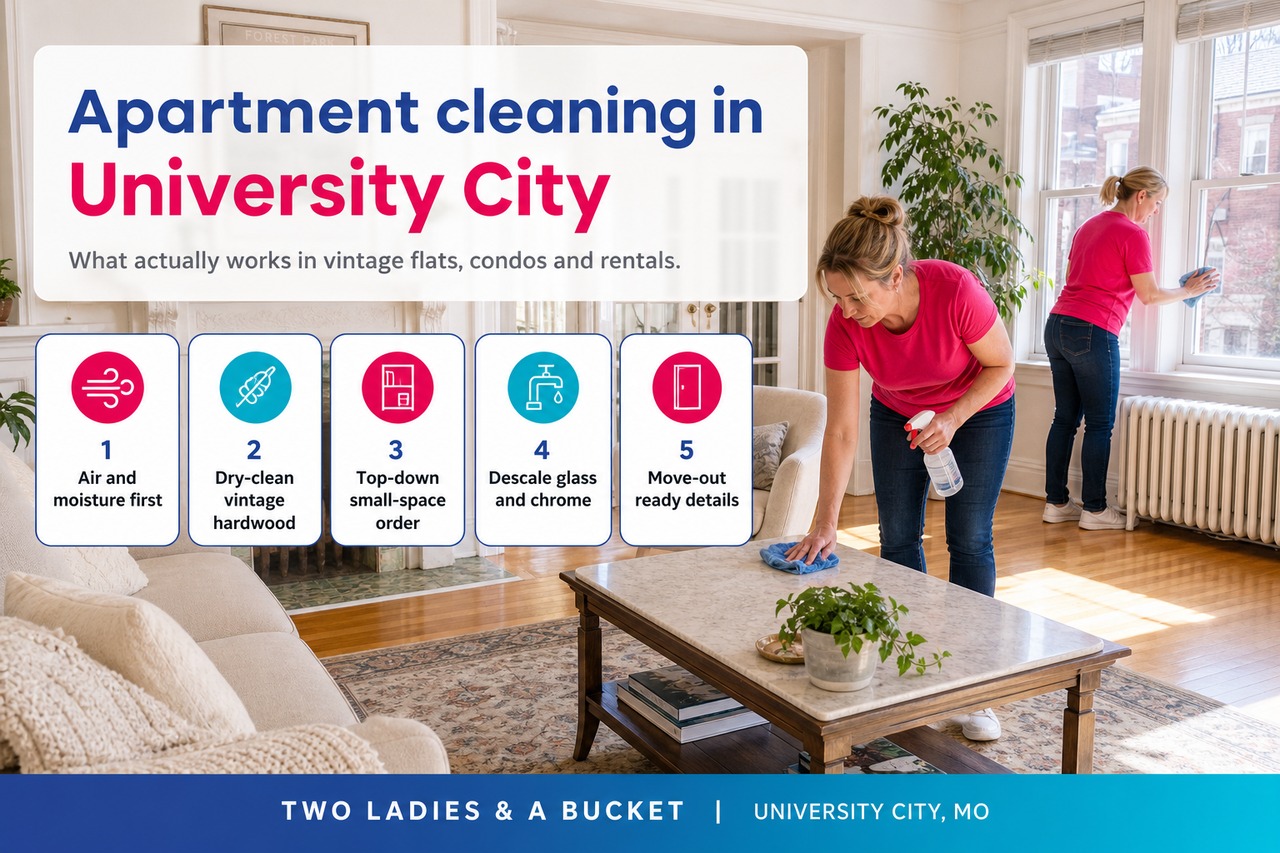
- Prioritize air and moisture in University City apartments: run the bathroom fan 20 to 30 minutes, keep humidity 30% to 50%, open windows.
- Protect original hardwood and hex tile: dry soil first, use pH-neutral cleaner with barely damp microfiber, and add felt furniture pads.
- Follow small-space sequence: declutter, dry-dust high to low, apply cleaners with dwell time, floors last; coordinate pet, roommate, and entry routines.
University City housing doesn’t look like the rest of St. Louis County. Between the apartment buildings along the Delmar Loop, the four-family flats in the east end, the 1920s brick two-flats around Kingsland and Melville, and the condo buildings near Forsyth, a huge share of U City residents live in something other than a detached single-family home — and cleaning those spaces well takes a different playbook.
Small square footage sounds easier. In practice, apartments and condos concentrate everything: cooking odors have nowhere to go, one bathroom absorbs all the wear, radiators collect dust nothing else does, and there’s rarely a garage or mudroom to catch what comes in the front door. Here’s how we approach apartment cleaning in University City, and what actually works in these buildings.
What makes apartment cleaning in University City different
Three features show up again and again in U City buildings:
- Original hardwood or hex tile in pre-war buildings, often with decades of accumulated finish layers, and almost always without the subfloor forgiveness of newer construction.
- Steam or hot-water radiators and their painted covers, which bake dust onto hot metal and then convect it around the room.
- Plaster walls and ceilings with cove details and picture rails — beautiful, and excellent at holding dust while punishing anything wet.
Then there’s shared-building reality. Odors travel through common hallways and old ventilation chases. Bugs and dust migrate between units regardless of how spotless yours is. And in older buildings, exhaust fans are frequently underpowered or vented into a chase rather than outside, which means moisture in your bathroom lingers far longer than it would in a 2010s build.
Start with air and moisture, not surfaces
In a small space, the fastest visible improvement usually isn’t scrubbing — it’s controlling humidity and airflow.
- Run the bathroom fan longer than you think. Twenty to thirty minutes after a shower, not two. If your fan is weak, crack the door and add a window fan. The EPA’s guidance on moisture and mold is direct about this: mold needs moisture, and removing moisture is the control step, not bleaching visible spots.
- Keep indoor relative humidity between 30% and 50%. A $15 hygrometer tells you where you stand. In August in St. Louis, unconditioned apartments routinely sit above 65%, which is where mildew film on tile and musty closet odor start.
- Wipe window sills and tracks. Older single-pane and storm-window combinations condense heavily, and sills are where that water sits.
- Don’t block radiators with furniture. Airflow around them reduces the scorched-dust smell when heat first comes on in October.
Cooking odors in a small footprint
Many U City kitchens have a recirculating range hood — it filters and returns air to the room rather than venting outside. That means grease aerosol settles on nearby cabinet fronts, the ceiling above the range, and the wall behind it. Two habits help enormously: open a window while cooking anything at high heat, and wipe the wall and cabinet faces near the range weekly with a dilute degreaser. Grease left to cure is dramatically harder to remove later, and on painted plaster, aggressive later scrubbing takes the paint with it.
Cleaning original hardwood and hex tile the right way
Pre-war floors are worth protecting. The techniques that matter:
- Dry soil first, always. Vacuum or dust-mop before moisture. Grit is abrasive; dragging it around with a wet mop is what creates the dull traffic path down a hallway.
- pH-neutral cleaner, barely damp microfiber. Skip vinegar on wood. Acid dulls finishes, and on older shellac or wax finishes it does so quickly and permanently.
- Felt pads under every furniture leg, replaced when they load up with grit. In a small apartment, chairs move constantly across the same square footage.
- Unglazed hex tile in vintage bathrooms is porous. It cleans best with an alkaline cleaner and dwell time, and it stays clean far longer once professionally sealed.
One honest note: if a rented apartment’s floors are already worn through the finish, cleaning won’t restore them, and that’s a landlord conversation rather than a cleaning one. We’d rather tell you that upfront than take money for a result we can’t deliver.
The small-space cleaning sequence that saves time
Order of operations matters more in a 900-square-foot apartment than in a large house, because you can’t stage work in separate zones. The sequence our teams use:
- Declutter and clear surfaces first. You cannot clean around objects efficiently; you can only clean between them.
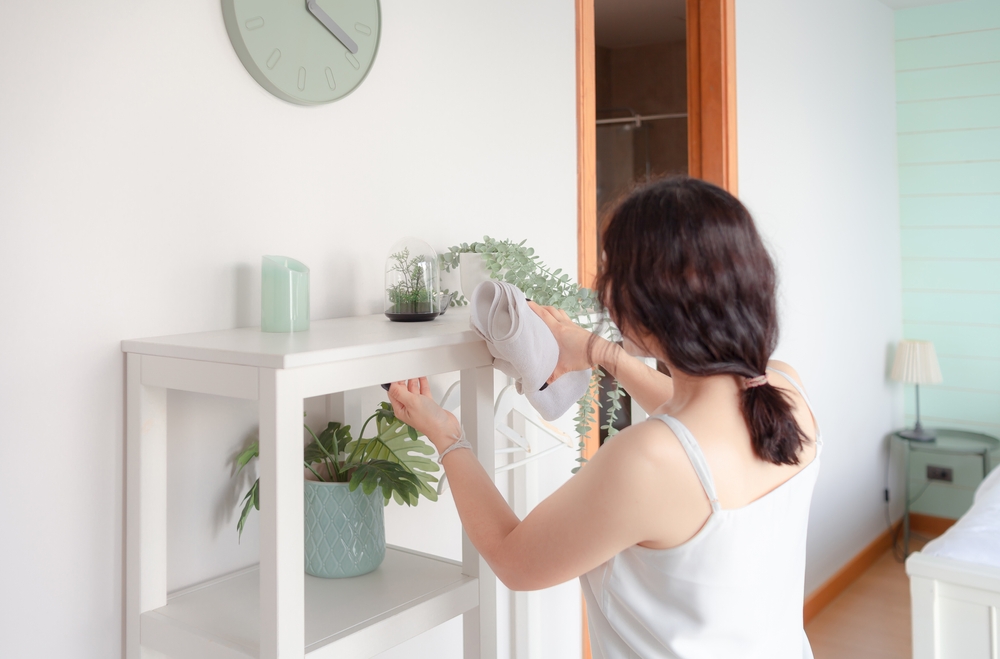
- Dry dust from high to low: light fixtures, tops of cabinets and bookshelves, picture rails, radiator covers, baseboards. Everything you dislodge falls, so floors come last.
- Bathroom and kitchen chemistry with dwell time. Apply cleaners, then leave the room and let them work while you do something else. This single change cuts scrubbing effort more than any product upgrade.
- Glass and mirrors after wet work, so splatter doesn’t undo them.
- Floors last, working out of the room toward the door.
In a small unit, this whole routine is realistically 90 minutes weekly — genuinely doable solo. Where it breaks down is the layer beneath: inside the oven, behind the toilet, the shower ceiling, the closet floors, the tops of door frames. Those are the tasks that make a difference at a move-out inspection and the ones that almost never happen on a busy week.
Pets, roommates, and dust in a shared unit
University City has one of the higher rental densities in the county, and shared units multiply the cleaning load in ways square footage doesn’t capture. A few things that genuinely help:
- Pet hair on upholstery: a rubber pet-hair brush or a slightly damp rubber glove lifts embedded hair that vacuum attachments skim over. Do this before vacuuming the floor, not after.
- Litter and food stations: place them on a washable mat, not directly on hardwood. Uric acid and moisture penetrate wood finish quickly, and that damage is not reversible with cleaning.
- Vacuum filtration matters more in small spaces. A sealed HEPA-filtered vacuum keeps fine dander in the machine instead of re-aerosolizing it into a room you’re standing in.
- Entry discipline: most U City apartments open directly into the living space. A shoe basket and a coarse mat at the door removes a surprising percentage of tracked soil before it ever reaches the floor you clean.
- Shared bathrooms need the mirror, sink, and toilet wiped daily and the shower treated weekly. Splitting by task rather than by week tends to work better between roommates — one person owns the bathroom, another owns the kitchen.
If you have allergies, our post on summer cleaning for pet owners covers the seasonal side of dander and humidity in more detail.
Hard water on glass, chrome, and stainless
St. Louis water is hard, typically 7–10 grains per gallon in the U City area, and apartments show it fast because the same shower gets used every day. Mineral scale is a deposit, not a stain — so it responds to mild acid, not to force.
- Treat shower glass with a dilute acidic cleaner, give it several minutes, then squeegee. Doing this weekly prevents the etched, permanently cloudy glass that eventually can’t be recovered.
- Never mix acidic cleaners with bleach. The combination releases chlorine gas — a real risk in a small bathroom with poor ventilation. The guidance in our own breakdown of cleaning products that should never be mixed is worth reading once.
- On stainless appliances, wipe with the grain and finish with a dry microfiber. Skip the oily “stainless polish” build-up; it collects fingerprints faster.
- A squeegee kept in the shower does more for a rental bathroom than any product on the shelf.
Renters, condo owners, and shared-building etiquette
Practical things worth knowing before you book any cleaning service in a U City building:
- Check building access rules. Many Delmar Loop and Forsyth buildings require guest registration, a fob, or a call-up. Telling your cleaning team upfront prevents a wasted trip.
- Note what’s yours versus the association’s. Common-area hallways, exterior windows, and balcony exteriors are frequently HOA-managed.
- Deposit protection. If you’re planning to move, a documented professional clean with before-and-after photos is the most reliable evidence you left the unit in good condition. Our move-out cleaning service is built for exactly that.
- Frequency. Small units usually do best on a monthly or biweekly professional rhythm with light weekly upkeep in between — see our comparison of weekly versus monthly service.
When to bring in a professional team
Honest answer: if you live alone in a tidy studio, you may not need us regularly. Where a professional service pays off in University City apartments and condos is when there’s a pet, a roommate, a demanding work schedule, an aging vintage bathroom, or a lease inspection on the horizon. Those are the situations where the “deeper layer” tasks accumulate faster than a weekend allows.
Two Ladies & A Bucket serves University City and the surrounding central corridor with vetted, consistent teams and cleaning plans built around your actual space — not a one-size template. Learn more on our University City house cleaning page, see the extras available on our add-on services page, or get a starting figure with an instant online estimate.
Have a specific question about your building or your floors? Get in touch — we’re happy to give you a straight answer, whether or not it ends in a booking.
Share this article
Related Posts




Follow us
A quick overview of the topics covered in this article.